Richard Kissling -The Swiss Sculptor Who Designed the Rizal Monument.
 |
| Richard Kissling with his dog |
Swiss sculptor Richard Kissling, the sculptor who designed the Rizal Monument, was born on April 14, 1848, Wolfwil, in the canton of Solothurn, Switzerland. As a young boy, he fashioned figures on dough, telling his parents of his wish of becoming a sculptor. Young Richard started his training in sculpturing as a plasterer in Solothurn. Then moving to stones and granite, his first commissioned works were gravestones. At age 22, he went to Rome to work and train under eminent Swiss sculptor Ferdinand Schloeth. (1818-1891)
After 13 years in Rome, he went back to Switzerland, where one of his works, a bust of Alfred Escher, was noticed in the Zürich Exposition of 1883. It won him a commission work to build the fountain/monument honoring Escher in the Hauptbahnhof Zürich (Zurich Central Railway Station).
Swiss National Hero
In 1892, Kissling won the competition to design the monument of Swiss national hero William Tell for the town of Altdorf in the canton of Schwyz. With 30 artists joining the contest, Kissling's design of William Tell with his arm around his son and a crossbow won first prize. The William Tell monument of Altdorf is probably Kisslings most famous work.
However, the story of William Tell continues to be a subject of scrutiny. Many Swiss historians have questioned, and still question, its authenticity, almost labeling it as a "Mythos." Was there indeed a real William Tell who lived and performed that famous 'Apfelschuss' (apple shot) off his son's head? Did a William Tell truly symbolize Swiss resistance against Habsburg incursions? In the 1905-1907 contest to design another monument for a hero, Kissling faced a figure quite unlike Tell, a hero who was a real historical figure. Interestingly, even today, Filipinos continue to debate Rizal's authenticity as the "National Hero of the Philippines".
.JPG) |
| Richard Kissling posing with the plaster model of perhaps his most famous opus-the the William Tell monument in 1893. The final bronze statue was then cast in the famous Thiébaut foundry in Paris. Almost two decades later, Kissling would also send the plaster model of the Rizal monument to the same foundry in Paris for casting. Photo courtesy of "Hommage a Kissling"-Kunst und Kulturverein Uri/ Erich Schenker |
Another National Hero
In mid-1905, Kissling read an ad about an international competition initiated by the Philippine government to design the monument of Filipino national hero José Rizal. It was actually the Schweizerischer Bundesrat or the Swiss Federal Council who received first the said ad and then passed it on to the Gesellschaft Schweizerische Maler, Bildhauer und Architekten or the Association of Swiss Painter, Sculptor, and Architect. So after getting the detailed features and photos of the subject and after doing research at a Zürich library, Kissling decided to join the competition. He then began his work on the scale model of the design he later would name and submit as "Motto Stella" (Guiding Star).
Winners were then announced in 1908, first prize going to "Al Martir de Bagumbayan" by Italian Carlo Nicoli, the second prize going to Kissling. Unfortunately, Nicoli was not able to sign the contract and also failed to file the required bond. The commissioned work was awarded to Kissling.
Wassen and Gothard Granite
In 1911, Kissling then began his work on the monument. The bronze statue of Rizal, including the figures around the central icon of the subject, was conceptualized in his Zürich atelier then cast in Paris. It was then transported to Wassen in the canton of Uri for mounting and measurement for its granite base, pedestal, and the obelisk. Wassen happens to be a place where the famous Gotthard Granite could be found. From there, Kissling quickly managed the necessary cut of the stones.
From the Alps, the cast bronze statue, the stones of the base and pedestal were transported via railway to neighboring France where a transport ship of the Atlantic, Gulf and Pacific Steamship Corporation brought it to the Philippines. The monument was then reassembled in Luneta.
On December 30, 1913, to commemorate the 17th year of Rizal's execution the "Motto Stella" was unveiled.
Forgotten
Richard Kissling died in Zürich on July 19, 1919 from a long lingering illness. The once famous artist of his country, who was once called "national sculptor of Switzerland," died forgotten, his "classic-heroic" style was already considered obsolete. It was said that the plaster model of one of his famous work "Alfred Escher Monument" was thrown in the Lake of Zürich.
POSTSCRIPT
 |
| The Swiss Federal Council of 1900- "Schweizerischer Bundesrat." The seven-member executive council which constitutes the federal government of Switzerland and serves as a collective head of state. The Bundesrat received the contest ad from the Philippine government. |
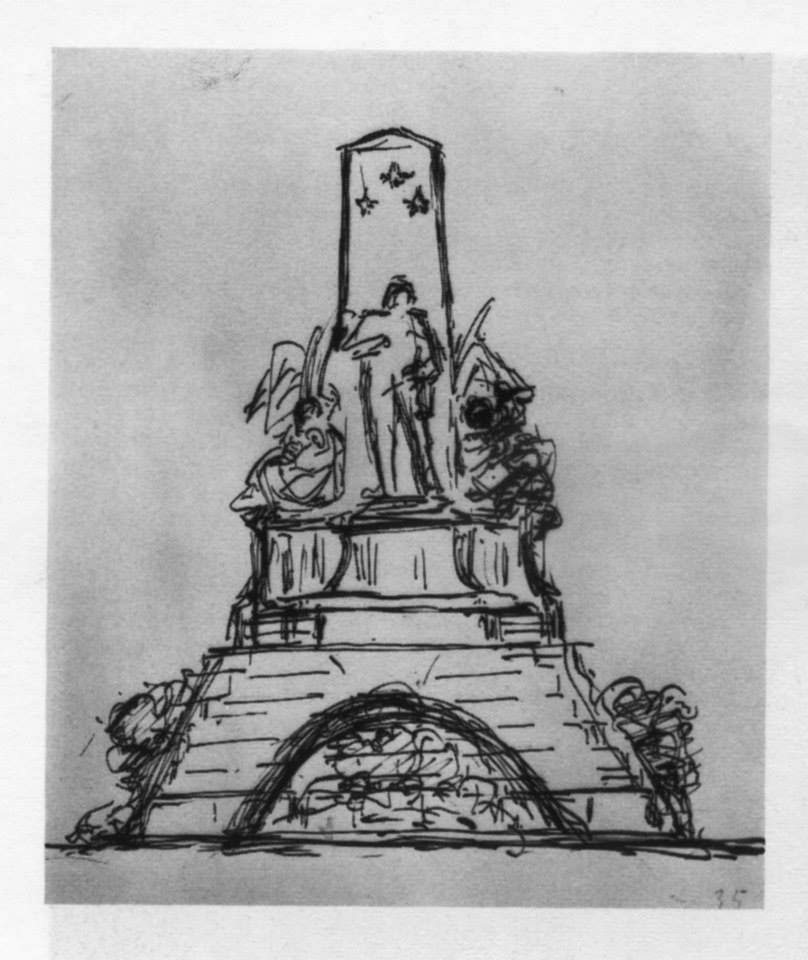 |
| Study on Rizal monument-Ink on paper. Perhaps the earliest plan by Kissling on the monument. Dated 1905. Kunsthaus Zurich. |
 |
| Photo of the plaster design (Entwurf, bozeto) of the Rizal monument. This was the one Kissling sent as his entry to Manila for the international competition-the search for the best design of a Rizal monument. Photo 1907. Courtesy of "Hommage a Kissling"-Kunst und Kulturverein Uri 1988/ Erich Schenker |
 |
| In the Swiss Alps. The monument during its mounting in Wassen. (Photo courtesy of Gemeinde Wassen/ Wassen Community Website, Uri, Switzerland) |
.jpg) |
| (The quarry for granite in Wassen. Where the stone of the obelisk and the pedestal of the Rizal monument was taken to the courtesy of Gemeinde Wassen/ Wassen Community Website, Uri, Switzerland) |
 |
| Motto Stella being assembled at Luneta. February 1913. Photo-Rizal Monument Executive Committee |
 |
| Kissling 1914 |
 |
| The William Tell monument in Altdorf. |
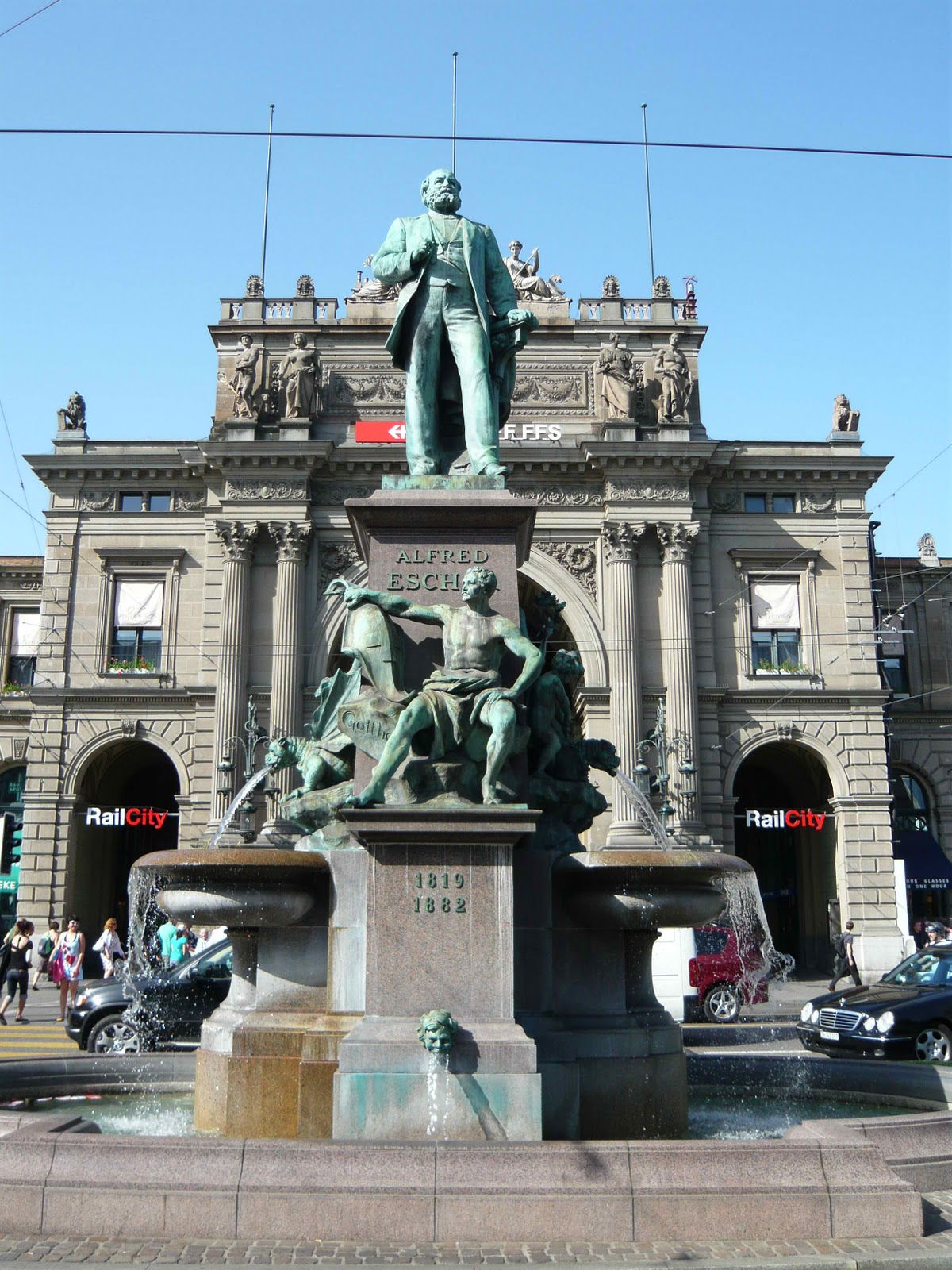 |
| Statue of Alfred Escher in Zurich central train station |
 |
| Rizal monument. Notice the similarity to the Escher statue revealing the style of the artist. |
.png)
_-_Google_Art_Project_2.jpg)

coooooooooooooooool !!!
ReplyDeleteKissling's PHENOMENAL sculpture of a man astride an eagle (with two other men trying to hang on to its talons as the eagle takes flight) is both magnificent and ignored at the old Lucerne train station. When my wife and I were in Lucerne 8 years ago, not even the "Tourist Information" office directly around the corner knew the name of the sculptor nor even that the sculpture existed. The sole sculpture on newsstand postcards being sold was that of a dying lion who 'represented' the lives of Swiss mercenaries who died in the mid-20th-century war. Tourists flocked around the dying lion. Every day that my wife and I made our pilgrimage to the man astride the flying eagle, not one person joined us looking up at him (atop his high column base). -- Len and Joyce Berkman
ReplyDelete