Posts

Manila - October 1897

Image
Every picture tells a story: The city was adorned with triumphal arches celebrating the glory of the Spanish crown and the army. But no conquering Caesar was riding a chariot. What was seen instead was a bunch of young Spanish lads squeezed out of the depleting manpower of the empire. The needed reinforcement long-awaited by the loyal subjects of Spain had finally arrive d. Thousands of miles away, from her last dominion in the Caribbean, upheavals, and revolutions were raging. In Spain itself, agitation heightens each day as different political groups wrestle for attention: The liberals, the conservatives, and the anarchists. Manila was under Martial Law since August of '96. The fresh troops gave the city a false sense of security. Soon these soldiers would be put into action, to hunt down the revolutionaries in the forest, in the marshes and in the countrysides outside of Manila. Every picture tells a story: A man watches as troops cross the "Puente de EspaƱa'',...

Taste That Launched A Thousand Ships

Image
From "De Novis Insulis" (Insule Moluccae-Cosmographia Universalis) ca. 1552-1558, Basel, Switzerland/Sebastian Muenster I recently stumbled upon a recipe book describing Venetian cooking in the 15th Century—a time often considered the pinnacle of Venice's grandeur as a maritime and commercial power. During this era, Venice stood as a hub of bustling warehouses where spices were traded. Clearly, the influence of the Turkish quarter had seeped into the palates of its citizens. However, despite being a mere speck in the expansive Mediterranean landscape, the yearning for spiciness had already been spreading across Europe. The term "spiciness" would later find expression in various Latin words linked to individual spices, like "caryophyllum" (also known as "gariophilum"), referring to the clove flower bud. The word "gingiber," derived from the ancient Greek term "zingiberis," or harking back to an even more archaic Indo-Eur...

Teating?

Image
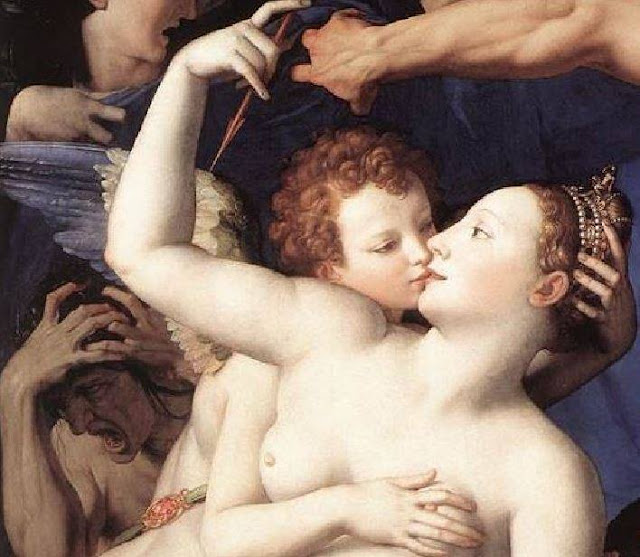
Venus, Cupid, Folly and Time (detail) by Bronzino  Thoughts about this Bronzino allegorical opus came to me today, Valentine's day.  I focused my attention on the central figures. Indeed a whirlwind of a canvas --Venus holding Cupid's wayward arrow with the naughty youngster himself in a rather awkward kiss to the goddess as his hand explores her mammary territories which perhaps Freud surely celebrated later as Oedipian. Some will argue it's just the mark of a "teating" c hild. Or have you ever heard of the Tagalog term "nangungutong"? (utong= teats) At the back lurks a hideous figure said to be representing "jealousy". Again, I thought of the right Tagalog word for it. "Selos" is rather Hispanic in concept and of course in origin. But the right Tagalog term could be "panibugho", which is darker, more sinister. Some in the medical fields years ago pointed it out rather scrupulously that the ravaged figure resembles tha...

"Spanferkel Romanze"

Image
Early chronicles describe the animal " to be stubborn and unfriendly". In some parts of the world, pigs were successfully domesticated. But in the Fertile Crescent, the semi-nomadic life of some known early tribes is partly blamed for the failure of domestication. The arid-dry land with limited water sources posed a big problem to pig herds who need a constant high amount of water. Its marauding ways, the type of feeding the animals do, often scavenging with its snout on many unclean things that it often took as feeds, added up to the general repugnance towards the animal and the unlikelihood of domestication. Thus swine was never considered part of livestock in the greater part of the Middle East, instead, pork became a prohibition that later was interpreted more like a religious and a cultural taboo. In Europe, in the Middle Ages, Jews were often ridiculed as "red men" having skin pigment similar to that of pigs. Even the Jewish religious tradition of circumcisi...

Carlos Bulosan And the Tragedy He Wrote

Image
This photo reminds me of the stories of Carlos Bulosan -- his fabled prose of Philippine countryside, later to be defined as his love letters to his homeland. I was once holding a book of Bulosan with his photograph on it and one of my sisters then said he looked like the comedian "Bayani Casimiro". I did not respond but then I asked myself: Can a picture t ell the tragic life one had lived or the funny side of our being? The story I'm referring to was Bulosan's "My Father's Tragedy". All about that extension of Filipino male machismo which happens, oftentimes, to be the prize bird. Somehow Filipino men were depicted in illustrations, old photos, from Spanish time down to the early years of the 20th century, holding their fighting cocks. (sorry for the term if the language seems to be indiscreet) If the medieval rulers of Europe and Arabia had falconry, nomadic tribesmen of the Asian Steppe hunt with their trained eagles, Filipino males have their ...

Luna was an Hispanophile

Image
 Juan Luna's "The Philippines and Spain on the road to the Temple of Glory" In a letter to Ferdinand Blumentritt Jose Rizal mentioned Juan Luna's travail with a committee for a group of Spanish artists who disallowed Luna to highlight his work in an exhibition. The Spanish Senate allowed him and yet this group would not for the simple reason, stated rather sarcastically by Rizal in German as "Kurz und Klar, es w ill nicht, weil es will nicht".."(Short and clear, it won't, because it doesn't want to"). Kumbaga ehh wala ng ibang dahilan kundi "ayaw". In the next sentence, Rizal went on with this so-called "I told you so mood", saying he and Blumentritt were right all along. Implying those racial overtones of that time...or how Spaniards take Filipinos as inferior. Rizal then gave a sweeping declaration about his friend; "Luna war ein Hispanophile, so dass er wollte nie etwas gegen Spanien malen" (Luna was a...

Reflections in a Golden Ear

Image
I still recall a discussion I had with my Singaporean friend about Chinese migration to Peninsular Malaya in the late 19th century via the seaport of the Lion City. He also shared his family's history—how his ancestors began by selling noodles (Hokkien Mee) in Ipoh, Malaysia. "Of course, your kinsfolk in Manila were into those things as well," I remarked. Then I added, "They did the dirty jobs the Spaniards and native Filipinos wouldn't do. Name it—they did it… even cleaning ears! I realized that some of the wealthiest families in the Philippines today trace their ancestry to Hokkien Chinese." "Oh, they were a bunch of lonely migrants!" my friend interjected. He then continued, "If you talk about the barbers and ear cleaners of Kuala Lumpur, I know the street where they had their so-called shops. And they had apprentices—can you believe that? They took in new arrivals from the mainland, vagabonds with no means of living, and turned t...