Posts

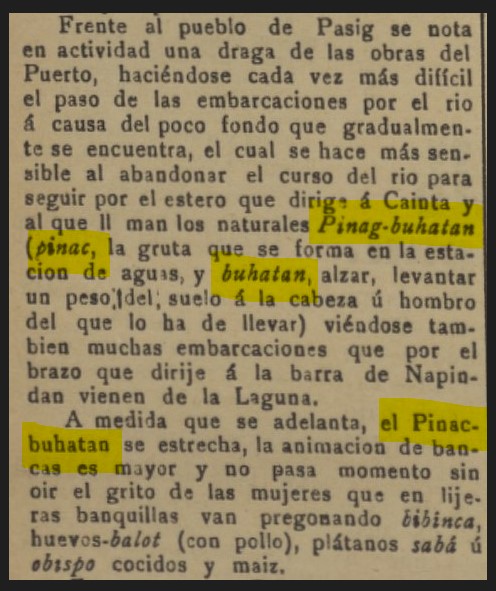
Pinagbuhatan and Bitukang Manok -- What's in a Name?
Image
Bitukang Manok--It is often romanticized now as the river of the revolution in Pasig.The waterway that Bonifacio and his close associates traversed on the way to Pasig for an assembly, where the decision to raise arms was reached in May 1896. It is now being referred to as Bitukang Manok yet nowhere in the early memoirs and journals of the revolution was it ever called as such. What's in a name? Meanwhile, Bitukang Manok traverse first to what many believe as its boca--the mouth, its beginning . For this reason, does the place fits its name in Tagalog -- Pinagbuhatan? What's in a name? PINAGBUHATAN In the mid-1990s, eminent Pasig historian Dr. Luciano PR Santiago hinted at the possibility that the first mission in Pasig founded by the Spaniards in 1572 could actually be Pinagbuhatan. He suggested that the men of Legazpi reached the area on the feast day of San Sebastian, January 20, thereby establishing the foundation of the church and the new mission under the name and protec...

"Kagungo", Manila Bay, and Other Phenomenon.

Image
  Manila Bay was once defined as the biggest septic tank in the world. It is not at all surprising that it has turned into a depository of refuse since many waterways and canals in the metropolis are somehow connected with the bay. We just don't have the modern facility to get rid of our waste, that a considerable amount of it ends in our waters. Above all, no Philippine government has initiated an honest to goodness rehabilitation of Manila Bay, the canals and waterways of the Metro. Fishkills and other environmental mishaps that come should not be taken as a surprise. We should actually be more startled that somehow Manila Bay could still host life. Filipinos should also be informed of the interesting relation of Manila Bay (seawater) to other bodies of water within the South Luzon area, take for example Pasig River (freshwater). Fishing in Manila Bay. 1900 There was a time when Manila Bay and the Laguna de Bay was just one big body of water. There were excavations revealing se...

Lingering Questions On Katipunan Events In Pasig -- "Nagsabado"

Image
The morning of August 29, 1896, Saturday, was uncommon for the commander of the Guardia Civil in Pasig Lt. Manuel Sityar. It was supposed to be "tiangge," but just across the street from his detachment where he stood, he saw the market half empty. From the church down to the plaza, it was silent, strangely silent. Although Sityar had some knowledge and morbid apprehension about specific gatherings of men in the wee hours months before in his area of designation, he was clueless on what was about to transpire. By dusk, it had become apparent. Pasig Katipuneros were attacking the Spanish detachment. Sityar might have thought only of a small disturbance, but what he was facing that time was non-other than the beginning of the revolution. Later to be called -- "Nagsabado" Pasig historian Dean Carlos Tech, the foremost narrator of Nagsabado described the event: "Nightfall of August 29, the men from the Pasig barrios of Pineda, Bagong Ilog and Ugong crossed the San ...

Lingering Questions On Katipunan Events in Pasig -- "Asamblea Magna"

Image
In the latter part of the 1990s, as the country prepared for the Centennial year celebration, the city of Pasig embarked on a grand endeavor: documenting and discussing its role in the founding of the nation, particularly its connection with the Katipunan. Pasig, often considered a stronghold of the Supremo, Andres Bonifacio, was central to this historical exploration. Indeed, civic groups were formed, public discussions held, commemorations organized, and historical markers erected, all aimed at highlighting Pasig's historical significance. In the process, a substantial amount of literature on the subject was published. One of the foremost topics of discussion revolved around Katipunan themes, including the "Asamblea Magna," "Nagsabado," "Bitukang Manok," and more. Local government units also took part by placing historical markers, some of which were done without the support of verified documents or rigorous research. Now, two decades later, with the...

Rizal@159

Image
Pencil sketch by Rizal -- Port city of Aden (Yemen). Near the entrance to the Suez Canal. May 28, 1882. I always maintain that one great source of Rizal's thoughts is his correspondence. Collected letters which somehow give one that advantageous glimpse of who the man was. His biographers often mention only some quotations from this correspondence that often leaves the more curious in us, asking for more. In June of 1882 (138 years ago), Rizal's ship was navigating the Suez Canal on i ts way to Europe. He had a letter to his parents and siblings (dated June 7), written in Spanish, mentioning the event. But another interesting letter to the family followed two weeks after the Suez crossing when Rizal was already in Barcelona. It describes his experience setting foot for the first time in Europe -- his intellectual homeland. The letter goes: "We descended there were four of us and accompanied by a cicerone (tour guide).  We toured the city. It was the first Europe I ...

"Opium War"

Image
Tatlong gabing katahimikan. Ngayon ko lang napansin na naipon na pala sa aking mesa ang ilang librong may patungkol sa China at mga Tsino. Inaaral ang kalaban? O naghahanap ng dahilan upang ituring na kakampi? Opyo at ang papel nito sa kasaysayan ng China -- iyan marahil ang pinakamalaking dahilan kung bakit tila may kipkip na sama ng loob ang nasabing higante ng Asya sa mga bansang kanluranin.  Kung nasa Beijing ka daw, subukan mong hanapin ang labi o ruins ng "Summer Palace" ng Qing Dynasty, sigurado may makakahalubilo kang ilang Tsinong maghahayag ng kanilang paghihinayang sa lugar at pagka- inis sa mga sumira nito -- ang mga British at French. Kapag nakikita ko ang ilang imahe ng mga kasalukuyang protesta sa Hong Kong, sumasagi naman sa isipan ko itong unang "Opium War" na pinaglabanan ng Britannia at Imperyo  ng China sa ilalim ng Qing Dynasty noong 1840's. Sa mga hindi pamilyar, ganito yan: Mahilig sa kanilang "afternoon tea" ang mga...

"There is no true civil liberty in America"-- Rizal

Image
I was reading the reports about the riots in the US brought by the death of a black suspect in the hands of a white policeman when I recalled one popular impression of Jose Rizal has had on the country. In a letter to his friend Mariano Ponce dated 27 July 1888, Rizal wrote: "Visité las más grandes ciudades de América, con sus grand iosos edificios, sus luces eléctricas y sus concepciones grandiosas. La América es indudablemente un gran país, pero tiene aún muchos defectos. No hay verdadera libertad civil...." ~ " I visited the largest cities in America, with its great buildings, its electric lights, and its great concepts. America is undoubtedly a great country, but it still has many flaws. There is no true civil liberty." A few years later, in his essay "Filipinas dentro de cien años" (The Philippines a century hence), Rizal predicted the possibility of the US intervening in the Philippines. He was correct. I always wonder whether Rizal would als...