Posts

Whatever Happened to Camilo Polavieja?
Image
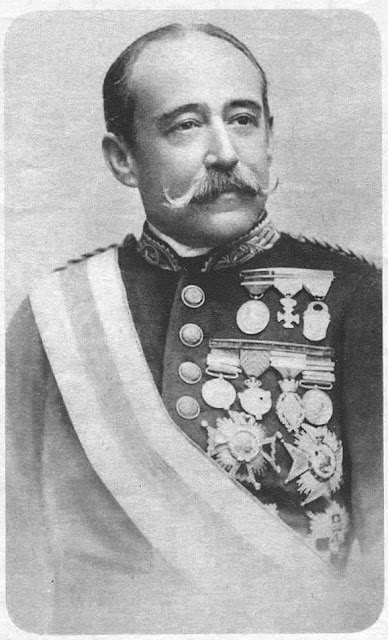
Camilo Polavieja y del Castillo, Marques de Polavieja  (1838–1914) Regarded as a villain in Philippine history for ordering the court-martial and subsequent execution of José Rizal, Governor-General Camilo de Polavieja had an illustrious career as a military officer. He assumed the position of Governor-General of the Philippines during a turbulent period, succeeding Governor-General Ramón Blanco y Arenas. Polavieja was notably favored by the powerful friar orders of the time. It is said that when Doña Teodora, Rizal's mother, pleaded for her son’s life, she reportedly approached Malacañang Palace on bended knees. Upon meeting Polavieja, he coldly declared, "I cannot spare the life of this rebel while young Spanish soldiers are dying on the battlefields of Luzon." Another version of the story suggests that Doña Teodora and one of her daughters were merely dismissed at the palace gates without an audience. Polavieja ultimately failed to pacify the Philippine Revolution...

AN ACT OF REVENGE FOR RIZAL

Image
Illustration of the assassination of Canovas by J Passos, J. Cuchy and V. Gines     . It was in one mild summer in the  spa Santa Águeda, in Mondragón, Guipúzcoa, (the Basque region of Spain) when Prime Minister  Antonio Cánovas del Castillo met his brutal end.    The assassin,  Michele Angiolillo, an Italian anarchist, posing as a tourist and traveling with a false identity, was able to approach Canovas and shot the Prime Minister point-blank. Angiolillo was subsequ ently arrested and during the investigation claimed that he acted alone and that the killing was an act of vengeance for the execution and torture of the Montjuich prisoners involved in the Barcelona 1896 Corpus Christi procession bomb attack and for the execution of Filipino patriot Jose P. Rizal. Angiolillo was sentenced to die by "garrotte," which was carried out on August 20, 1897. During the execution, he  was calm and showed no remorse.  Canovas del Castillo would ...

Falange in the Philippines

Image
 Manila 1938. Falange gathering with prominent Spanish-Filipinos (Soriano, Zobel, et al.) doing a "saluto romano." Jose Antonio Primo de Rivera (1903-1933) "Falange", the Spanish rightist group, was founded in 1933 by Antonio Primo de Rivera, son of Miguel Primo de Rivera (the Spani sh dictator who was at the Biak Na Bato -- who acted as the Governor General's representative). It was the leading party in Gen Francisco Franco's front in the Spanish Civil War. Many Falange members perished in that war. Falange reached the shores of the Philippines before WWII and recruited prominent names of Filipino of Spanish ancestry in its rank. Among the activities of the ultra-rightist group was to gather support for Gen Francisco Franco and the "nationalist."   In the Philippines, the role of the Falange has left unanswered questions. How much influence did its prominent members had in the government during the com...

The Last Bourbon Rulers of the Philippines

Image
The statue of Queen Ysabel II . Inaugurated in Manila on 14, July 1860 (Lithograph by Ramirez y Giraudier)  Ysabel II About 150 years ago, the Philippines had a woman as its ruler, and our forefathers might have indeed shouted, "Viva la Reina!" She reigned during a turbulent and pivotal period, not only for Spain but also for its colonies, including the Philippines. Queen Ysabel II was highly unpopular and was deposed in a revolution led by some of her generals in 1868. Following the queen's downfall and subsequent exile in France, Spain dispatched a liberal Governor-General named Carlos María de la Torre y Navacerrada to the Philippines. He implemented extensive reforms for the colony and gained the affection of the Filipinos. Regrettably, the Spanish Cortes reinstated the monarchy and selected an Italian nobleman, Amadeo I, as the new king in 1871. De la Torre was recalled, and a new Governor-General named Rafael de Izquierdo y Gutiérrez took his place. Perhaps one of...

Trinidad H. Pardo de Tavera - Deserves a Second Look?

Image
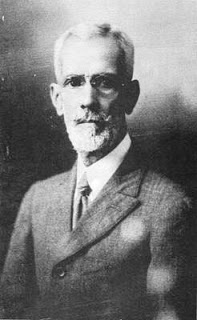
      Trinidad Hermenegildo Pardo de  Tavera y Gorricho (1857-1925). Filipino physician and historian. An outstanding Filipinologist who wrote notable scholarly works in various fields of Oriental and Philippine studies; language, anthropology, folklore, etc. His training and qualification as a doctor are immense. T T. H Pardo de Tavera received his licentiate in medicine at the Fa culté de Médecine de Paris and his bachelor in medicine also in the same institution. In the mid-1880s, he enrolled in École nationale des langues orientales vivantes (now Institut national des langues et civilisations orientales) and took courses under Pierre Étienne Lazare Favre. In December 1885, he received his diploma in the Malay language.  One of Pardo de Tavera's book 'Plantas Medicinales de Filipinas' is an outstanding study on the different medicinal plants of the country. But as a politician, history seems to be unkind to T.H Pardo de Tavera. Perhaps he always went to the w...

My Remembrance of Quijano de Manila

Image
Well, let me tell you this; there's so many things written or people writing about him: some, too fancy or academical, some really quite a bore. Let me get it straight...He likes Cole Porter, practically anything that is Porter. Right from the first bar, he'll start swinging his hands like a maestro conducting a big band. Now, why do I know that? Well, I should know...I played in front of him many times, and I love the way he asked for his favorite tune...He'll raise one hand to catch your attention, points his finger at you, and will quickly say....."Cole Porter!" Now that is style.... the man simply got it. I never approached him, and he never came near us. But when he is in the hotel lobby, he would gaze around to find me. Then that great nod. I knew then my evening would be a swing. No! When he's there, I won't start my set with his Porter. No...no. I will wait for him to tell me. He has his rituals. He must have his San Mig first. He must have ...

Jose Corazon de Jesus- "Ang Manok Kong Bulik"

Image
Remembering One Favorite Tagalog Poem Early 1900 Philippine postcard. the ever popular "Sabong" Ang Manok Kong Bulik   ni Jose Corazon de Jesus Linggo ng umaga. Ang nayo'y tahimik, ang maraming dampa'y naro't nakapinid liban na sa ibong maagang umawit ay wala ka man lang marinig sa bukid... Di-kaginsaginsa'y aking naulinig ang pagtitilaok ng manok kong bulik, ako'y napabangon at aking naisip: Pintakasi ngayon! May sabong sa Pasig! Gadali pa halos ang taas ng Araw sa likod ng gintong bundok ng Silangan ay kinuha ko na sa kanyang kulungan ang manok kong bulik na sadyang panlaban... Kay-kisig na bulik! At aking hinusay bawa't balahibong nasira ang hanay, ang palong ay aking hinimas ng laway, binughan ng aso nang upang tumapang! Muling nagtilaok nang napakahaba at saka gumiri nang lalong magara, kumkukutok-kutok pa't kumahig sa lupa, napalatak ako nang hindi kawasa... Ang aking puhunang sampung piso yata'y ...