Posts

Aguinaldo's Plan To Resurrect The Katipunan August 1900

Image
                         Emilio Aguinaldo (1869-1964) The President On the Run The biggest tragedy in the short-lived Malolos Republic was that some names identified with it were either opportunist, fence-sitters, or worst, turncoats that not even the brilliant mind of Mabini could muster enough force to check that time the growing influence in the government of such personalities as Pedro Paterno et al. "Collaborators"... that was how Emilio Aguinaldo labeled Pedro Paterno when he found out that the latter was favoring an American take over of the Philippines. Months after the outbreak of the Filipino-American War, Aguinaldo was on the run and was  planning to direct a guerilla warfare in the jungles of Luzon. The sad reality was, most of the prominent Filipinos who were once part of his government had simply abandoned him and went to the other side. Aguinaldo then turned to his former Prime Minist...
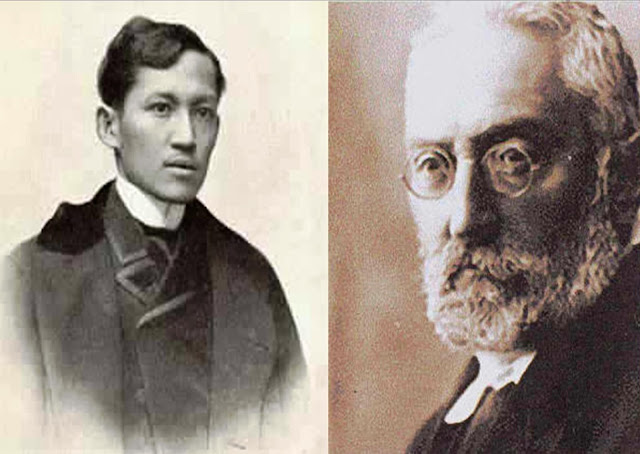
Rizal and Unamuno. The October 1936 Incident at the Universidad de Salamanca.

Image
Jose Rizal (1861-1896) & Miguel de Unamuno (1864-1936) In his "Epilogo" for Jose Rizal's biography written by Wenceslao E. Retana, Spanish poet/philosopher Miguel de Unamuno mentioned about the possibility of him having seen Rizal, that their paths must have crossed each other many times in the Universidad Central de Madrid, where both have been students. Unamuno wrote:  "Rizal estudió Filosofía y  Letras en Madrid por los mismos años en que estudiaba yo en la misma Facultad, aunque él estaba acabándola cuando yo la empezaba. Debí de haber visto más de una vez al tagalo en los vulgarismos claustros de la Universidad Central, debí de haberme cruzado más de una vez con él mientras soñábamos Rizal en sus Filipinas y yo en mi Vasconia.” Translation: "Rizal studied Philosophy and Letters in Madrid during the same years I attended the same Faculty, although he was finishing his studies when I was just beginning mine. I must have seen the Tagalog scho...

"SIGLO DE ORO" in Manila's Streets and Plazas

Image
  Lope de Vega (1562-1635) In Rizal Avenue (Avenida area in Manila)  there is a street called LOPE DE VEGA named after the famous Spanish playwright of the Baroque period, Félix Lope de Vega y Carpio (1562-1635). Because we are separated now from the Spanish language, we hardly read or even know him. Some of us get only that chance to see or hear something abou t Lope de Vega, say if Instituto Cervantes, Manila would feature something about the Spanish playwright.  Looking at the street names and plazas of Manila you will also find Zurbaran, Cervantes, and Calderon de la Barca, they do not only tell of Spanish heritage in the country  but also Spanish history itself. Those names were representative of a period when Spanish arts and literature flourished. The period is known as "SIGLO DE ORO" -- the golden age. Francisco de Zurbarán   (1598-1664) Self portrait as Saint Luke .  Known mainly for his works with religious themes, Zurbarán...

Rizal's favorite- "THE COUNT OF MONTE-CRISTO"

Image
Alexandre Dumas (1802-1870) As a young student, Jose Rizal read and admired the novel "The Count of Monte-Cristo" by  French  author Alexandre Dumas (père). Quite often people who read Rizal and this work of Dumas, relay the character of Edmond Dantes with that of Simoun (El Filibusterismo). The plot of revenge and the lonely figure of an avenging hero is too similar to be ignored. The difference c ame in the ending of the two novels. While Edmond Dantes found fulfillment in his life, Rizal gave a tragic end for Simoun (Ibarra).  The ever present themes of 19th Century "Romanticism" are found not only in the works of Rizal but also even in the way he conducted his life. "Canto del Viajero" (poem of Rizal) reminds one of the many adventures of Edmond Dantes.  Is there really an Edmond Dantes in Jose Rizal?    El Conde de Monte-Cristo. Spanish Edition   

CHARLES II OF SPAIN- "El Hechizado"

Image
Charles II of Spain by Juan Miranda Carreon) Believe it or not, this monarch once ruled a vast empire that includes the Philippines. This is Carlos II (reigned 1665-1700) also known as Carlos "el Hechizado" (the Hexed). A Hapsburg monarch. Scientists and historians of today believes his strange physical features was the result of excessive inbreeding,  since it w as a common practice among the monarchs like the Hapsburg to match cousins to cousins and even uncles to nieces. Carlos II was born physically and mentally disabled, and disfigured. He died without an heir, thereby ending the Hapsburg line and ushering in the reign of the house of Bourbon in Spain and its colonies.     

Ang "Spice Trade" sa Kasaysayan Ng Pilipinas

Image
Ng marating ng mga Griyego sa pamumuno ni "Alexander the Great" ang Persia, Palestina, Arabia at India (ca. 300 BC). Namangha sila sa mga eksotikong pamamaraan ng paghahanda at pagpreserba ng mga lutuin at pagkain ng mga bansang nasakop nila gamit ang mga kilalang "Spices". Ang mga Romano  (Romans) naman ay pinilit alamin ang ruta o "trade routes" ng nasabing kalakal. Subalit noong pa man panahong iyon, kontrolado na ng mga Arabians o Arabo at ilang ilang nasyon sa silangan (East) ang pangangalakal ng mga eksotikong produkto tulad ng "Spices". Ang tanong ng mga Europeo..."Saan nanggaling ito?" Sa kadahilanang mahirap at tila malayo ang pinagkukunan, naging mahal ang presyo ng nasabing spices sa mercado ng Europa. Kadalasan mga hari at mga royalty o yung mga dugong bughaw lamang ang nakakabili at nakagagamit nito. Halimbawa, noong panahong medieval,  ang "Piper Nigrum" - black pepper o paminta ay tinawag na "black gold...

Jose Rizal's Bomb Plot

Image
Victorian lamp The Plot Even before international terrorists adopted the horrific tactics of suicide bombers and bomb couriers in their campaigns of vengeance, Philippine national hero José Rizal conceived a plot in his novel El Filibusterismo that involved a catastrophic explosion to ignite a revolution. In Chapters 34 and 35, Simoun arrives at the wedding reception of Juanito Pelaez and Paulita Gomez bearing a seemingly innocuous gift – a lamp. However, concealed within it is a potent explosive: nitroglycerin. The reception takes place at the former residence of the deceased Captain Tiago, which Simoun has meticulously rigged with explosives beforehand. According to his plan, the lamp will remain lit for only twenty minutes before flickering. If anyone attempts to adjust the wick, a catastrophic explosion will ensue, claiming the lives of all those gathered – a significant portion of Manila's elite, including prominent figures from both civil society and the church hierarch...