Posts

A Peek to 16th Century Print Houses

Image
When details of Columbus' voyage reached the royal houses of Europe, there was this frantic desire to know more. Insatiable curiosities would not only die down. Bitin sila! Of course, the uhs and ahhs were centered first to the gory tales of strange creatures, monsters or animals beyond description, giant trees, walking plants, cannibals, and also treasures.  In the end, what was also proven was this hidden human desire to retell, to know what's new. Cartographers battle it out to get the exact details, location, or a thing to measure depicting the newfound terraform in their maps. Often consultations to those who knew were simply lacking that several maps and illustrations turned out to be hilarious, close to a caricature- with beasts and strange humans occupying much of the curiosities. The language was a problem? In the beginning, not so much so, since the demand for information came mostly from those who speak Latin. But when commodities and more curiosities from the...

Our Shared History With The Moluccas

Image
Looking at this 17th-century French engraving, many might ask about the distinguishing features: Who are the Moluccans? Who are the inhabitants of the Philippines? On a more profound analogy, one tends to recall the early years of Spanish conquest when both the Moluccas and the Philippines were somehow grouped into one together with other  Pacific islands. It was known then as the "Spanish East Indies." This could somehow explain why some books and journals in the 16th to the 17th Century often discussed both archipelagos collectively.                               "Habitans des Philippines, des Moluques et des Isles de la Sonde". from                                        Illustrations de Nouvelle géographie / Martineau. Ca 1700. Early travel books often illustrate inhabitants of the places discuss inacc...

Magellan's King -- 1519

Image
The young Charles V -  circa 1515 by Bernard van Orley. Modern readers might immediately notice the outrageous hairstyle and, of course, the famous Hapsburg jaw. He had two different names or designations in the two vast dominions he inherited and ruled. From his father, Philip "the Handsome" of Hapsburg, he inherited the German territories, the Low Countries, and Flanders (modern-day Netherlands and Belgium). From his mother, the Spanish Infanta (Princess) Juana "La Loca" (the Mad), he inherited the kingdoms of Spain. Indeed, the best of European worlds. Proof that good looks and madness are a potent mix? Ahh, if not for the chin! To the Germanic states, he was "Karl der Fünfte" or Karl V, "Kaiser des Heiligen Römischen Reiches Deutscher Nation" (Charles V of the Holy Roman Empire of the German Nation). To the Spanish kingdoms, he was simply Carlos I (Carlos Primero). Yes, also the namesake of the famous Brandy de Jerez. Carlos I was the ne...

"Plus Ultra"

Image
Portrait of Charles V -- 1519 (Woodcut) By Albrecht Dürer. After Hans Weiditz the Younger Again, the jaw is quite prominent. But I discuss this more for the symbolism found in this print. First, it's dated 1519, Charles V ascended into the Spanish throne in 1517. Technically he was just Carlos I. His appointment and the crown as Charles V of the Holy Roman Empire would come later 1520. On the top are the three coats of arms. The middle one, with a double-headed black eagle, that's the Hapsburg coat of arms-- from the paternal side. Now the other two are the standards of Naples and that of Castile-Leon, the kingdoms he inherited from his mother's side. Grabe sa pamana! Below the coats of arms is the representation of two Pillars of Hercules, which, according to Greek mythology, were built by Hercules himself near the Straits of Gibraltar to mark the edge of the world. The pillars bore the inscription "Nec plus ultra" (also Non plus ultra, "nothing farther b...

Seville - The Umbilical Cord

Image
Seville- seen here with the famous port and the Guadalquivir River. 17th Century-- Anonymous Flemish painter. I define the Guadalquivir River (Baetis-Roman name) as the beginning part of the long "umbilical cord" that connects us to one placental fiber - Spain. It was from here where Magellan launched the expedition that eventually led to the European discovery of our archipelago and brought the island group to the awareness of the West. Eventually, Spain would unite these islands into one and ruled it for almost three centuries. Five hundred years ago, the same month of July, Magellan gathered his armada in the port of Seville. In the first week of August 1519, the fleet would then moved to the mouth of the Guadalquivir River facing the Atlantic-- Sanlúcar de Barrameda. The first step in the search for a westerly route towards the Spice Islands (Indonesia). No defined maps, no sure direction after the Atlantic. It was sheer intuition, the belief that somehow a passage...

Instruction from the king. 1519 -- to Magellan and Falero

Image
This is just a handwritten copy from the files of documents: "Papeles tocantes a las Islas Maluco y Filipinas, causados desde el año 1519 hasta el 1547". The original can be found in "Archivo General de Indias" in Seville. Seville Spain, five hundred years ago, the first half of 1519. Magellan's fleet was in the final pace of preparation for an expedition quite different. Series of communique, letters were sent and received. It was first described as a voyage shrouded in secrecy but as soon as preparation started, intrigues also spread between the two Iberian kingdoms fighting it out for the dominance of the sea routes that lead to the riches of the world. May 1519- Magellan was still sharing the command of the expedition with his friend Ruy Falero,(as seen in this handwritten copy - "Instrucción" from the king himself, Carlos I. Falero is often described in some accounts as unconventional, with his approaches to astronomy and astrology ...

Elcano: The Very First Around the Globe?

Image
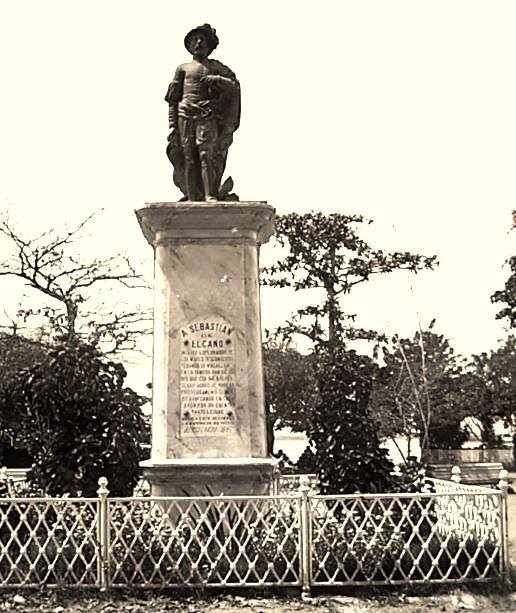
The monument of Juan Sebastián Elcano. Cavite 1900. Some statues and illustrations depict Elcano with a globe and the Latin inscription; "Primus circumdedisti me" (You went around me first). But does he deserve the credit being the first to circumnavigate the world? Who is Elcano? Filipinos might ask..... A street in Binondo? Sorry for Elcano, the very first history lesson every Filipinos come to know is that boring repetition; "Who discovered the Philippines?" Almost everyone would answer. Yes, Filipinos know Magellan even just in name. Magellan incidentally was also the leader whom Elcano and some of his Spanish colleagues mutinied against in that famous expedition the world now commemorates. (500th anniversary of the first voyage around the globe). If not for the Italian chronicler Pigafetta, who was very much pro-Magellan, Elcano might have run away with the title and the monicker. Yet in Spain they honor Elcano. In the whole of the Iberian Penin...