Posts

Something About Juan Luna's "SPOLIARIUM"

Image
Contemplating upon Spoliarium Definitions The Latin word "Spoliarium" refers to a holding area in the Roman Colosseum where the corpses of fallen gladiators were brought. If a gladiator met his death in the arena, a ceremony would begin in which a man dressed like Charon would claim the body. The gladiator's weapons, like his "gladius" (meaning sword, hence the term "gladiator"), would be gathered or collected. A group of Roman slaves or workers would then come in to collect the corpse. They would drag the body from the sandy arena using chains and a large hook attached to the carcass. However, if it was a legendary gladiator, they would carry him on a stretcher, entering through a gate appropriately called the "Porta Libintinaria" (or the entrance of Libitina). Libitina is an ancient Roman goddess of funerals and burial. These people who took care of the corpses, or the undertakers, were collectively known as "libitinarii." Today, ...

Migration Fuels Human Development

Image
                               Migration has always been the fuel of human development. Think about this, if our ancestors, the very first 'Homo Sapiens' did not leave the primordial home Africa, perhaps things would turn out differently, or worse, this branch of human species would have gone into extinction. From the moment Homo Sapiens moved out of that original home, a stunning feat of migrat ion, a new pace of human evolution began. This movement from one place to varied environments had impacted that social skills of thinking, enhancing more than innate quality in him, fashioning tools and weapons, a way to adapt in the ever-changing realities of the surroundings presented to him. (Obviously a reference to Darwinian adaptive evolution). The movement of humans was also a movement of groups, tribes, and communities. From this, migrating tribes developed their own unique signals or calls in hunting, moving...

ILANG PAKSA PATUNGKOL SA ISYU NG SABAH

Image
I. NAGING KAKULANGAN NG PILIPINAS SA SABAH Marahil kung mayroon dapat sisihin sa pagkakapunta ng Sabah sa kamay ng Malaysia ito ay ang mabagal at malamyang "foreign policy" ng Pilipinas sa Sabah noong binubuo pa lamang ang Malayan Federation (1950's-1960's).  Kilala ang Britania sa pagiging bihasa sa stratehiya ng kanyang foreign policy subalit hindi  nakuhang sabayan ng mga namumuno ng Pilipinas ang utakang nangyari noon. Marami sanang realidad ang nagamit o na "exploit" ang Pilipinas , subalit naging mabagal ang bansa.  Halimbawa: 1) Ang isa sa kinikilalang at nirerespetong  lider noon ng Sabah ay si Donald Stephens (Fuad Stephens) isang Kristiano, nagmumula sa ethnic group na "Kadazan". May agam agam si Stephens sa pagsama ng Sabah sa federasyon ng Malaya sa dahilang may takot siya sa dominasyon ng mga Malayo sa katulad nilang hindi muslim. Sa katunayan opsiyon sa kanya at sa ibang kasama sa liderato ang isang malayang o independent na ...

ANG SUPREMO BILANG ALAGAD NG SINING

Image
Ang tanging larawan ng Supremo Si Andres Bonifacio ay hindi lamang isang organisador at mandirigma. Katulad ng mga kilalang pangalan sa kasaysayan, sa Pilipinas man o ibang lugar, nakita nya at nagamit ang halaga ng "Sining" sa pag gising ng diwa ng mga mamamayan. Gaano man kapayak, ang supremo ay naging aktor sa tanghalan ng "Moro-Moro" sa kanyang lugar sa Tondo. Kasama ang ilang kaibigan i tinatag ni Bonifacio ang isang grupo tinawag nilang "Teatro Porvenir" (Teatro ng Kinabukasan o Theater of the Future).  Ang hangarin ay pagbutihin ang kaalaman sa Tagalog at pananagalog. Pinag ukulan din nya ng panahon alamin at busisiin ang mga alamat na humalo na sa kamalayan Pilipino tulad ng alamat ni Bernardo Carpio. "Teatro Porvenir" maaari nangangahulugan din Teatro ng mga simpleng tao, ng mga pangkaraniwang uri. Naalala ko tuloy ang isang halimbawa ng opera noong ika 18.siglo sa Europa, ang "Opera Buffa" at ang "Zarzuela" ng...

Federico Espino Licsi (1939-2011)

Image
                                                                   CELIA                                      Pasa, pasa silenciosa, sin luciérnagas de piedra Se llama Celia en el pueblo que sabe de su dolor, El pueblo al borde del agua…                              Y se viste de tristeza Por su novio pescador que murióse en la borrasca: El viento iracundo daba vuelta y más  vuelta. Llovía En la mente y temblaba el pueblo bajo el relámpago Ranchas del fr í o habagat prestaban filo a la espuma Y dentadura a las olas. Tormenta y tormento duros Para una ...

Aguinaldo's Plan To Resurrect The Katipunan August 1900

Image
                         Emilio Aguinaldo (1869-1964) The President On the Run The biggest tragedy in the short-lived Malolos Republic was that some names identified with it were either opportunist, fence-sitters, or worst, turncoats that not even the brilliant mind of Mabini could muster enough force to check that time the growing influence in the government of such personalities as Pedro Paterno et al. "Collaborators"... that was how Emilio Aguinaldo labeled Pedro Paterno when he found out that the latter was favoring an American take over of the Philippines. Months after the outbreak of the Filipino-American War, Aguinaldo was on the run and was  planning to direct a guerilla warfare in the jungles of Luzon. The sad reality was, most of the prominent Filipinos who were once part of his government had simply abandoned him and went to the other side. Aguinaldo then turned to his former Prime Minist...

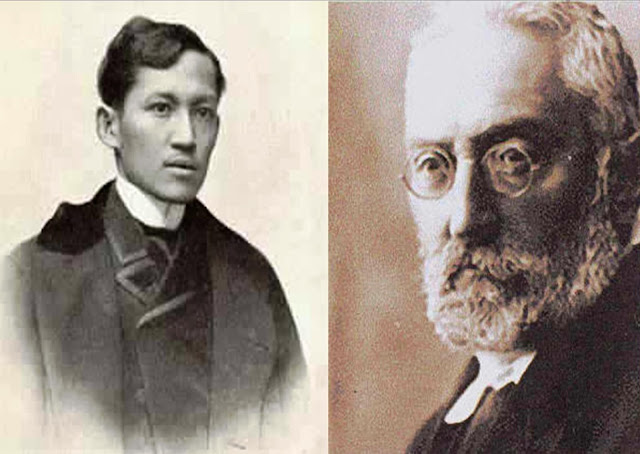
Rizal and Unamuno. The October 1936 Incident at the Universidad de Salamanca.

Image
Jose Rizal (1861-1896) & Miguel de Unamuno (1864-1936) In his "Epilogo" for Jose Rizal's biography written by Wenceslao E. Retana, Spanish poet/philosopher Miguel de Unamuno mentioned about the possibility of him having seen Rizal, that their paths must have crossed each other many times in the Universidad Central de Madrid, where both have been students. Unamuno wrote:  "Rizal estudió Filosofía y  Letras en Madrid por los mismos años en que estudiaba yo en la misma Facultad, aunque él estaba acabándola cuando yo la empezaba. Debí de haber visto más de una vez al tagalo en los vulgarismos claustros de la Universidad Central, debí de haberme cruzado más de una vez con él mientras soñábamos Rizal en sus Filipinas y yo en mi Vasconia.” Translation: "Rizal studied Philosophy and Letters in Madrid during the same years I attended the same Faculty, although he was finishing his studies when I was just beginning mine. I must have seen the Tagalog scho...