Posts

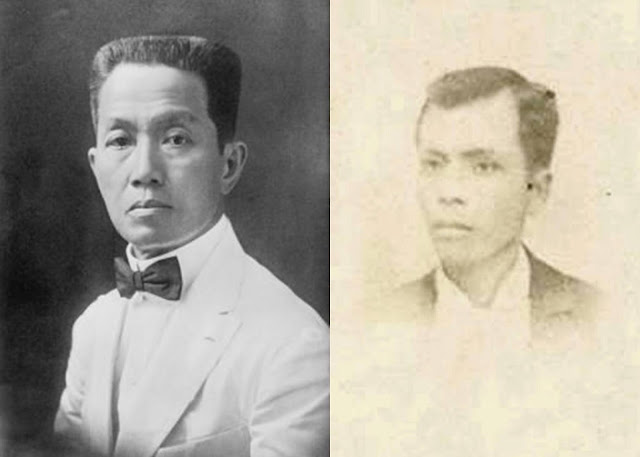
AGUINALDO - BONIFACIO- Their views in the "Asamblea Magna" at Pasig. May 1896.
Image
The "Asamblea Magna" at  Pasig. May 1896. (Gen. Santiago Alvarez-Memoir) On May 3, 1896, a general meeting among Katipunan leaders called by Supremo Andres Bonifacio was held in Pasig. The venue was the house of local Katipunan leader, Valentin Cruz located near the Pasig church of the Immaculate Conception. The meeting would be known as the "Asamblea Magna". Perhaps one of the most revealing events in the history of the Katipunan. The meeting was held to appraise what the Supremo called "difficulties with which our Society is beset. "The movement had been exposed. Bonifacio wanted to act and start the uprising so as no to be forced against the wall. He asked the assembly, "What is your decision? Shall we rise in revolt now?" Aguinaldo then took the floor and cautioned the Supremo against acting hastily. Suggesting a thorough assessment of the situation and then saying: "I am against rising in arms now while we are not yet prep...

The Watchman of Old Manila

Image
                       A watchman of Madrid. 1832. Drawing by Juan Carrafa (BNE). I haven't seen yet                                 illustrations or photos of  "Sereno" of Manila. It heightens more curiosities.                    In the acclaimed short story "May Day Eve" by Nick Joaquin, the narrative opens and closes with a watchman's proclamation: "Guardia sereno-o-o! A las doce han dado-o-o!" (This translates to "Night watch! Its twelve midnight!") Joaquin vividly recreates a centuries-old tradition from Spanish Manila, one with roots in medieval Spain: the sereno, a night watchman. This watchman system was a common feature in European medieval towns. Communities within walled cities employed them to patrol the streets and announce the passing hours. Interestingly, the hourly call...

Malacca and the Spice Trade

Image
Portuguese Malacca drawing by Pedro Barreto Resende. In the book Livro das Plantas de Todas as Fortalezas, Cidades"  by Antonio Bacaro, Goa 1635                   "Whoever is lord of Malacca has his hand on the throat of Venice" .-The famous line of the 16th-century Portuguese chronicler Tome Pires highlighting the importance of Malacca (part of Malaysia) to the Spice trade. But long before the arrival of European maritime powers Portugal and Spain in Southeast Asia, spices were already making its wa y to Europe. From the fabled Spice Islands in the Moluccas (part of Indonesia), Malay and Chinese traders would navigate the dangerous seas to bring the commodities to different ports of the region.  From Malacca, Arab and Indian traders set the prices and take the goods,  crossing the waters of the Indian subcontinent and then heading towards important ports of Arabia where caravans would then take the land routes towards the...

Minding Mabini

Image
"When the people launched the war, I believed it was my duty to be by their side and help them in their struggle to the end; now that they feel they have lost the strength to continue fighting for their rights, I believe I ought to be by their side, to tell them that they should not despair but that they should have confidence in themselves, injustice, and in the future." ~ Apolinario Mabini One sure thing can be said about Mabini: he indeed had a hard life. Born poor, his family struggled to secure him a good education. His biographer vividly describes this as a "chronic lack of financial means." Paralyzed by adult polio at the age of 32, he had to live with the constant stigma that disability brings. But his brilliant mind was his true gift, and he gave the new republic not only its legal foundations but also its moral and intellectual direction. Mabini also entertained the idea of a greater Malayan confederacy and the emancipation of colonized people. He was a ma...

Something About Juan Luna's "SPOLIARIUM"

Image
Contemplating upon Spoliarium Definitions The Latin word "Spoliarium" refers to a holding area in the Roman Colosseum where the corpses of fallen gladiators were brought. If a gladiator met his death in the arena, a ceremony would begin in which a man dressed like Charon would claim the body. The gladiator's weapons, like his "gladius" (meaning sword, hence the term "gladiator"), would be gathered or collected. A group of Roman slaves or workers would then come in to collect the corpse. They would drag the body from the sandy arena using chains and a large hook attached to the carcass. However, if it was a legendary gladiator, they would carry him on a stretcher, entering through a gate appropriately called the "Porta Libintinaria" (or the entrance of Libitina). Libitina is an ancient Roman goddess of funerals and burial. These people who took care of the corpses, or the undertakers, were collectively known as "libitinarii." Today, ...

Migration Fuels Human Development

Image
                               Migration has always been the fuel of human development. Think about this, if our ancestors, the very first 'Homo Sapiens' did not leave the primordial home Africa, perhaps things would turn out differently, or worse, this branch of human species would have gone into extinction. From the moment Homo Sapiens moved out of that original home, a stunning feat of migrat ion, a new pace of human evolution began. This movement from one place to varied environments had impacted that social skills of thinking, enhancing more than innate quality in him, fashioning tools and weapons, a way to adapt in the ever-changing realities of the surroundings presented to him. (Obviously a reference to Darwinian adaptive evolution). The movement of humans was also a movement of groups, tribes, and communities. From this, migrating tribes developed their own unique signals or calls in hunting, moving...

ILANG PAKSA PATUNGKOL SA ISYU NG SABAH

Image
I. NAGING KAKULANGAN NG PILIPINAS SA SABAH Marahil kung mayroon dapat sisihin sa pagkakapunta ng Sabah sa kamay ng Malaysia ito ay ang mabagal at malamyang "foreign policy" ng Pilipinas sa Sabah noong binubuo pa lamang ang Malayan Federation (1950's-1960's).  Kilala ang Britania sa pagiging bihasa sa stratehiya ng kanyang foreign policy subalit hindi  nakuhang sabayan ng mga namumuno ng Pilipinas ang utakang nangyari noon. Marami sanang realidad ang nagamit o na "exploit" ang Pilipinas , subalit naging mabagal ang bansa.  Halimbawa: 1) Ang isa sa kinikilalang at nirerespetong  lider noon ng Sabah ay si Donald Stephens (Fuad Stephens) isang Kristiano, nagmumula sa ethnic group na "Kadazan". May agam agam si Stephens sa pagsama ng Sabah sa federasyon ng Malaya sa dahilang may takot siya sa dominasyon ng mga Malayo sa katulad nilang hindi muslim. Sa katunayan opsiyon sa kanya at sa ibang kasama sa liderato ang isang malayang o independent na ...