Posts

"Eisernes Kreuz- Erste Klasse" Medalya ni Adolf Hitler.

Image
Ang di umano'y larawan ni Hitler. nakasabit ang medalyang  "Eisernes Kreuz-Erste Klasse" Iron Cross-first class, iyan ang klasipikasyon ng pangalawang iron cross na medalya ni Hitler noong Unang Digmaan Pandaigdig. "Loner" daw sabi ng mga kasama niya sa bunker. Masyadong seryoso sa conviction nya at pilosopiya (Weltanschauung) sa punto na may kakaiba na siyang dating. Close to saying-may katok sa ulo. Na promote sa pagiging ka bo, mensahero siya runner o "Meldegänger" sa isang regimento, Ang gawain ay maghatid ng mensahe/ komunikasyon sa mga kalapit na regimiento. Sa isang labanan kung saan kinailangan ng matindi ang mga mensahero na halos naubos, pinatunayan diumano ni Hitler ang kanyang pakinabang,  kaya nga "Eisernes Kreuz - Erste Klasse" (Iron Cross First Class) ang katumbas na medalya.  Marami pag aaral ang inilunsad  upang alamin talaga ang tunay na Hitler noong WWI, alamin din ang totoo tungkol sa mga medalyang ito. Marami ...

The Blumentritt-Schuchardt Correspondence

Image
I have always pointed out to colleagues who are somehow into Germanistik (German Studies), Philology, and Philippine Studies the incredible amount of data, studies, and possibilities that scholars could learn just researching on both the writings of Ferdinand Blumentritt and Rizal. University of Graz (Austria), a few years ago opened its "Sammlung" or collection of the Blumentritt-Schuchardt Correspondence. Reading it, I was led to consider new territories to understand the beginnings and the minds within the Rizal and Blumentritt friendship. The letter posted here was written by Blumentritt to the eminent German linguist Hugo Schuchardt (1842 – 1927). Their correspondence, which lasted for almost 30 years would often talk about Rizal, the Philippine languages, and the situation in the country at that time. Very interesting to point out also that this letter of Blumentritt to Schuchardt dated 2. January 1882 mentions a Filipino who Blumentritt contacted in Paris an...

The Juan Luna Case

Image
One Paris newspaper accounts of the Luna case -- L'Affare Luna In the last week of September 1892, the Paris press was all abuzz, reporting on the sensational case of Juan Luna, a well-known figure in the Hispanic artistic community of Paris, who in a fit of jealous rage and marital dispute, shot and killed his wife and mother-in-law. The case was given different labels as newspapers came up with their own rhetoric of sensationalism, such as "la tragédie de la rue Pergolèse" and "L'affaire Luna," among others. Regional and provincial papers picked up the story, and in the succeeding weeks, it spread throughout France. Spanish papers, owing to Juan Luna's stature, also began their series of reports about the case. Later, one more enterprising Spanish journal would publish Antonio Luna's letter to a friend, sharing his brother's side of the story. The Luna case was arguably one of the most sensational events reported about a Filipino in the 19th ce...

BULLFIGHT IN MANILA

Image
Photo of a Manila bullfight in Paco --This is a preliminary part of the corrida, notice the toreros holding something like a barbeque stick? Those are "banderilleros". They test the ferocious nature of the animal, sticking the sharpened banderillas at the back of the bull. Wenceslao Retana, a former adversary who later became the biographer of José Rizal, offers a comprehensive account of bullfighting in the Philippines during the late 18th to 19th centuries in his book "Fiesta de Toros en Filipinas." One of the intriguing questions that arises from this historical narrative is: where did the bulls come from? In Spain, the tradition of "Ganadería de Brava" involves breeding bulls with outstanding bloodlines to ensure the animals' ferocity. A fighting bull, or "toro de Lidia," typically comes from a selected breed. To maintain its ferocious nature, breeders follow strict traditions, such as allowing the bull to roam freely in a free-rang...

"NAGSABADO SA PASIG" 1896

Image
"Nagsabado sa Pasig " is the term being used to describe and glorify the Katipunan action in Pasig on August 29, 1896-Saturday. In the early weeks leading to that fateful day in August, the commander of the Spanish detachment in Pasig, the then Lt. Manuel B. Sityar had been noticing uncommon gatherings of men in the wee hours of the night in the areas of Pasig and Mandaluyong. But the rainy season had prevented him from investigating and learning  more of these gatherings. In fact, one of the most important Katipunan meetings the "Asamblea Magna",  happened in May of the same year in Pasig. Pasig town center in the late 1890s.  Seen here is the church and also the waterway, the famous "Bitukang Manok" When news that the Katipunan was finally revealed,  local Katipunan leader in Pasig, Gen. Valentin Cruz started sending secret feelers to the Katipuneros from different "visitas" or "barrios" around Pasig that uprising could happen ...

AGUINALDO - BONIFACIO- Their views in the "Asamblea Magna" at Pasig. May 1896.

Image
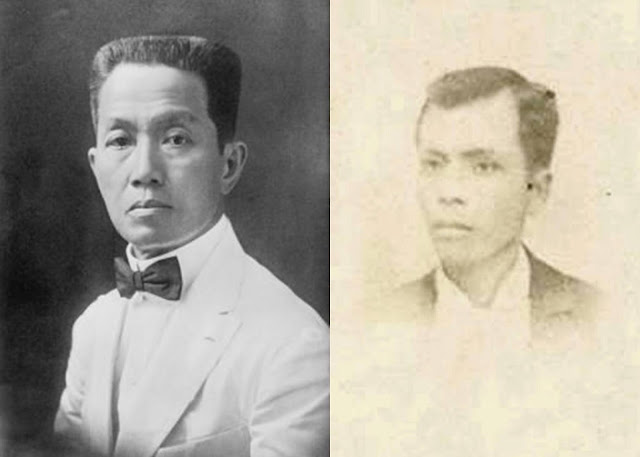
The "Asamblea Magna" at  Pasig. May 1896. (Gen. Santiago Alvarez-Memoir) On May 3, 1896, a general meeting among Katipunan leaders called by Supremo Andres Bonifacio was held in Pasig. The venue was the house of local Katipunan leader, Valentin Cruz located near the Pasig church of the Immaculate Conception. The meeting would be known as the "Asamblea Magna". Perhaps one of the most revealing events in the history of the Katipunan. The meeting was held to appraise what the Supremo called "difficulties with which our Society is beset. "The movement had been exposed. Bonifacio wanted to act and start the uprising so as no to be forced against the wall. He asked the assembly, "What is your decision? Shall we rise in revolt now?" Aguinaldo then took the floor and cautioned the Supremo against acting hastily. Suggesting a thorough assessment of the situation and then saying: "I am against rising in arms now while we are not yet prep...

The Watchman of Old Manila

Image
                       A watchman of Madrid. 1832. Drawing by Juan Carrafa (BNE). I haven't seen yet                                 illustrations or photos of  "Sereno" of Manila. It heightens more curiosities.                    In the acclaimed short story "May Day Eve" by Nick Joaquin, the narrative opens and closes with a watchman's proclamation: "Guardia sereno-o-o! A las doce han dado-o-o!" (This translates to "Night watch! Its twelve midnight!") Joaquin vividly recreates a centuries-old tradition from Spanish Manila, one with roots in medieval Spain: the sereno, a night watchman. This watchman system was a common feature in European medieval towns. Communities within walled cities employed them to patrol the streets and announce the passing hours. Interestingly, the hourly call...