Posts

Jose Rizal and the "Sturm und Drang"

Image
  "Sturm und Drang" was an 18th-century German literary and artistic movement, serving as the precursor to the broader Romantic Movement that emerged in 19th-century Europe. Rizal's early education introduced him to readings on Graeco-Roman literature, Spanish classics, and French authors like Dumas. However, once he arrived in Europe, his literary horizons expanded significantly. He referenced literary figures such as Heinrich Heine, Friedrich Schiller, and Johann Wolfgang von Goethe in his writings—authors associated with the German Sturm und Drang movement. In "Crisostomo Ibarra," Rizal created a character deeply rooted in the "Sturm und Drang" mold. Ibarra, a young and naive individual, possessed a belief in the power of reason and rationalism. He embarked on a mission to convey his ideas and ambitious plans to his homeland. Ibarra epitomized the mestizo figure, a product of the Age of Enlightenment and the sophisticated Asian response to liberal i...

Breakfast - Beethoven's no. 8

Image
  I often describe the symphony as "spielerisch" or playful. Although the opening theme of the 1st movement starts with a grand forte and vivace, the whole opus reminds one of the light hearted evenings of Vienna or the symphonic themes of his one time teacher, Papa Haydn. But above all this, it seems that Beethoven was telling us to take a deep breath, inhale (hinga muna), that eerie stillness and easy air before the coming of something gigantic -- the 9th. It was also the time when his mental faculties were greatly undermined by the deafness that engulfed him. Beethoven relied on a small notebook where people he conversed with could write their messages. He was by then getting detached with humanity because of this disability. He never really heard his last symphonies. Indeed tragic to anyone whose life is music. In the end, it's the same humanity he chose to do a "common union" , immortalizing with his music, the verses of Schiller that heralds the brotherh...

Ang Balak na Muling Paglusob ng Katipunan sa Pasig

Image
  Dokumento ng Katipunan - May Petsang 18 ng Disyembre 1896 Ayon sa nanaig na sanaysay sa mahabang panahon, matapos daw ang hindi matagumpay na paglusob sa San Juan, ang Supremo Andres Bonifacio kasama ang ilang kapanalig ay namundok o nagtago na lamang. Walang narinig, walang balita. Nitong mga nakaraang mga taon, sa paglabas ng mga bagong pag aaral, mga dokumento tungkol sa Katipunan na nasaliksik at nakuha sa "Archivo" ng Espanya, nabubuo ngayon ang kakaibang larawan ng Supremo. Imahe ng isang pinunong patuloy na nag organisa at patuloy na lumaban matapos ang mga pangyayari sa San Juan. Sa mga nasabi din bagong pag aaral, lalo pang tumibay at kuminang ang sanaysay patungkol sa papel na ginampanan ng sambayanang Pasigueno sa pag aaklas, lumitaw din ang malalim na ugnayan at relasyon sa pagitan ng Supremo Andres Bonifacio at ng Pasig. Ang hukbo ng Supremo na may bansag na "Mataas na Sanggunian ng Hilagaan" (Katipunan Northern Command) na kinabibilangan ng Mayni...

Pinagbuhatan and Bitukang Manok -- What's in a Name?

Image
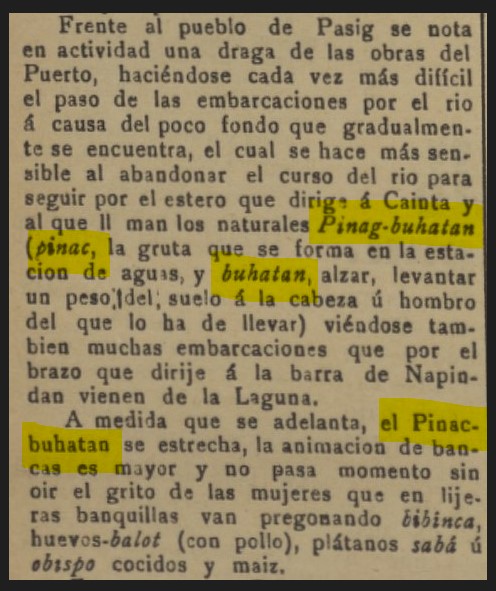
Bitukang Manok--It is often romanticized now as the river of the revolution in Pasig.The waterway that Bonifacio and his close associates traversed on the way to Pasig for an assembly, where the decision to raise arms was reached in May 1896. It is now being referred to as Bitukang Manok yet nowhere in the early memoirs and journals of the revolution was it ever called as such. What's in a name? Meanwhile, Bitukang Manok traverse first to what many believe as its boca--the mouth, its beginning . For this reason, does the place fits its name in Tagalog -- Pinagbuhatan? What's in a name? PINAGBUHATAN In the mid-1990s, eminent Pasig historian Dr. Luciano PR Santiago hinted at the possibility that the first mission in Pasig founded by the Spaniards in 1572 could actually be Pinagbuhatan. He suggested that the men of Legazpi reached the area on the feast day of San Sebastian, January 20, thereby establishing the foundation of the church and the new mission under the name and protec...

"Kagungo", Manila Bay, and Other Phenomenon.

Image
  Manila Bay was once defined as the biggest septic tank in the world. It is not at all surprising that it has turned into a depository of refuse since many waterways and canals in the metropolis are somehow connected with the bay. We just don't have the modern facility to get rid of our waste, that a considerable amount of it ends in our waters. Above all, no Philippine government has initiated an honest to goodness rehabilitation of Manila Bay, the canals and waterways of the Metro. Fishkills and other environmental mishaps that come should not be taken as a surprise. We should actually be more startled that somehow Manila Bay could still host life. Filipinos should also be informed of the interesting relation of Manila Bay (seawater) to other bodies of water within the South Luzon area, take for example Pasig River (freshwater). Fishing in Manila Bay. 1900 There was a time when Manila Bay and the Laguna de Bay was just one big body of water. There were excavations revealing se...

Lingering Questions On Katipunan Events In Pasig -- "Nagsabado"

Image
The morning of August 29, 1896, Saturday, was uncommon for the commander of the Guardia Civil in Pasig Lt. Manuel Sityar. It was supposed to be "tiangge," but just across the street from his detachment where he stood, he saw the market half empty. From the church down to the plaza, it was silent, strangely silent. Although Sityar had some knowledge and morbid apprehension about specific gatherings of men in the wee hours months before in his area of designation, he was clueless on what was about to transpire. By dusk, it had become apparent. Pasig Katipuneros were attacking the Spanish detachment. Sityar might have thought only of a small disturbance, but what he was facing that time was non-other than the beginning of the revolution. Later to be called -- "Nagsabado" Pasig historian Dean Carlos Tech, the foremost narrator of Nagsabado described the event: "Nightfall of August 29, the men from the Pasig barrios of Pineda, Bagong Ilog and Ugong crossed the San ...

Lingering Questions On Katipunan Events in Pasig -- "Asamblea Magna"

Image
In the latter part of the 1990s, as the country prepared for the Centennial year celebration, the city of Pasig embarked on a grand endeavor: documenting and discussing its role in the founding of the nation, particularly its connection with the Katipunan. Pasig, often considered a stronghold of the Supremo, Andres Bonifacio, was central to this historical exploration. Indeed, civic groups were formed, public discussions held, commemorations organized, and historical markers erected, all aimed at highlighting Pasig's historical significance. In the process, a substantial amount of literature on the subject was published. One of the foremost topics of discussion revolved around Katipunan themes, including the "Asamblea Magna," "Nagsabado," "Bitukang Manok," and more. Local government units also took part by placing historical markers, some of which were done without the support of verified documents or rigorous research. Now, two decades later, with the...